


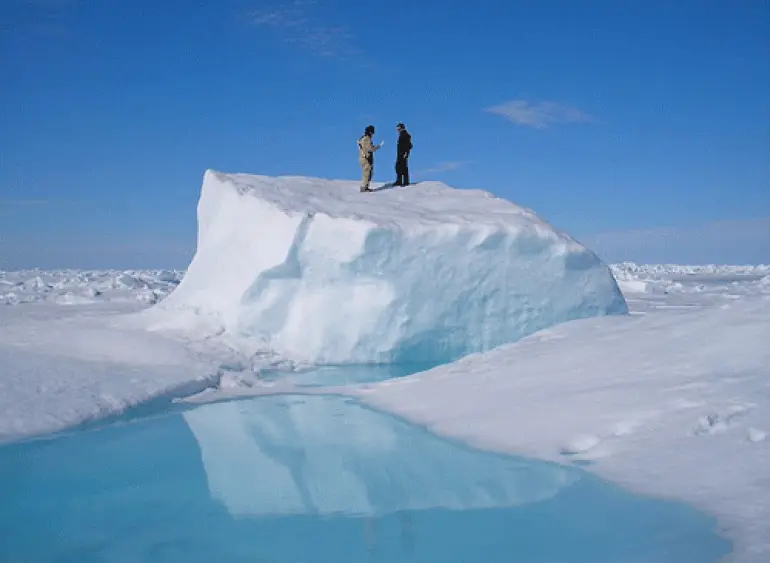
 Matt Druckenmiller, right, and his research advisor Hajo Eicken, a professor of Geophysics, on an ice floe near Utqiaġvik in about 2010. Photo by Daniel Pringle.
by Ned Rozell
Hajo Eicken had “everything I could ever ask for” in his former career at a German institute. Well, almost everything.
Eicken, for a few more weeks the director of the International Arctic Research Center at the University of Alaska Fairbanks, once studied glaciers and sea ice at the Alfred Wegener Institute in the northern Germany town of Bremerhaven.
But first, before I bury the lede: On March 9, 2026, after living in Fairbanks for 28 years (“the longest period of my existence so far”), Eicken will return to his hometown of Bremerhaven to become the leader of the Alfred Wegener Institute, where he started his career.
OK, now backing up: Despite a smooth career path laid out before him at the Alfred Wegener Institute, Eicken felt a niggling.
At that place, at about the same latitude as Edmonton, Eicken was not able to stand on glaciers or sea ice very often. To reach the latter, he needed to walk aboard an icebreaking ship that would take weeks to reach northern oceans upon which sea ice floats. Once his boots touched the ice, he rushed to get his samples.
“You would have just a few hours — always under the gun,” he said.
Then he got an opportunity to study at the University of Alaska Fairbanks, which featured much easier access to the ice that floats on the top of the world. Back then, in 1998, he visited some of the most stable sea ice anywhere on the planet, stuck to the shoreline off Barrow, now Utqiaġvik.
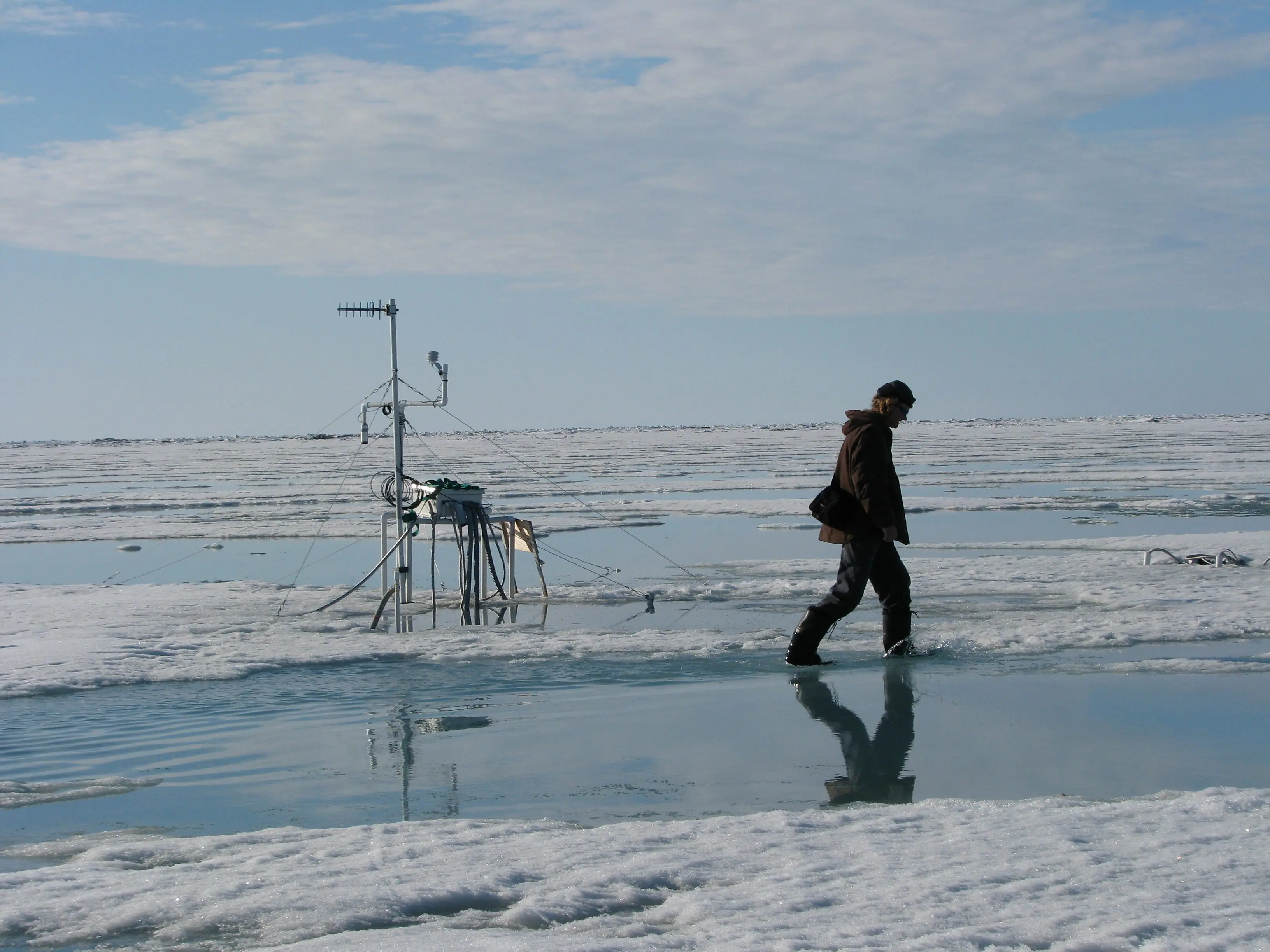 Hajo Eicken walks the sea ice off the town of Utqiaġvik in about 2010. Photo by Matt Druckenmiller.
There, on a blue-white platform offshore of the farthest-north town in America, he felt the brutal sting that wind adds to an ambient temperature of minus 40. He saw the footprints of polar bears and wondered how people could possibly live there.
His interest in those Indigenous people — and his inclusion of them in his research — helped define his career in Alaska.
“He came up to us one day and asked if we could help him out,” said lifelong Utqiaġvik resident Billy Adams, 60, an Inupiaq whaling captain. “He wanted us to show him some types (of sea ice). He was very professional about it and we were very eager to help him out.”
Over the years, as Eicken, also 60, returned for his own research and to introduce graduate students to the great white sheet, “he just kept on being the friendly guy we had always known,” Adams said.
Eicken considers locals who have spent decades hunting seals and bowhead whales from the sea ice to be the equivalent of scientists with doctorates. He thinks a few are even above that.
“The Inupiat already knew so much about the transformation going on (when sea ice extent diminished to a record low level in 2007),” Eicken said. “They might be monitoring 150 different variables across all areas of the environment.”
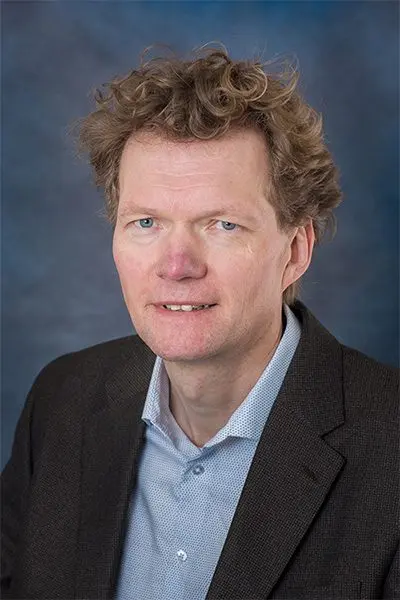 Hajo Eicken. Photo courtesy International Arctic Research Center.
Eicken’s Alaska career coincided with a staggering amount of sea ice loss, with 2025 being the lowest amount measured floating on the northern seas in winter since satellite observations began in 1979.
Utqiaġvik has warmed more than any town in America because of the dearth of that reflective sea ice once so common and long-lasting on its shores.
Eicken will continue working in Alaska and the rest of the Arctic as he transitions to the Alfred Wegener Institute, which is “an order of magnitude” larger than the International Arctic Research Center. And he will continue to ask for help from the locals.
“Being up there taught me that adaptation has to be driven by the community,” he said. “You have to adapt what you know to be relevant to that location.”
Since the late 1970s, the University of Alaska Fairbanks’ Geophysical Institute has provided this column free in cooperation with the UAF research community. Ned Rozell is a science writer for the Geophysical Institute.